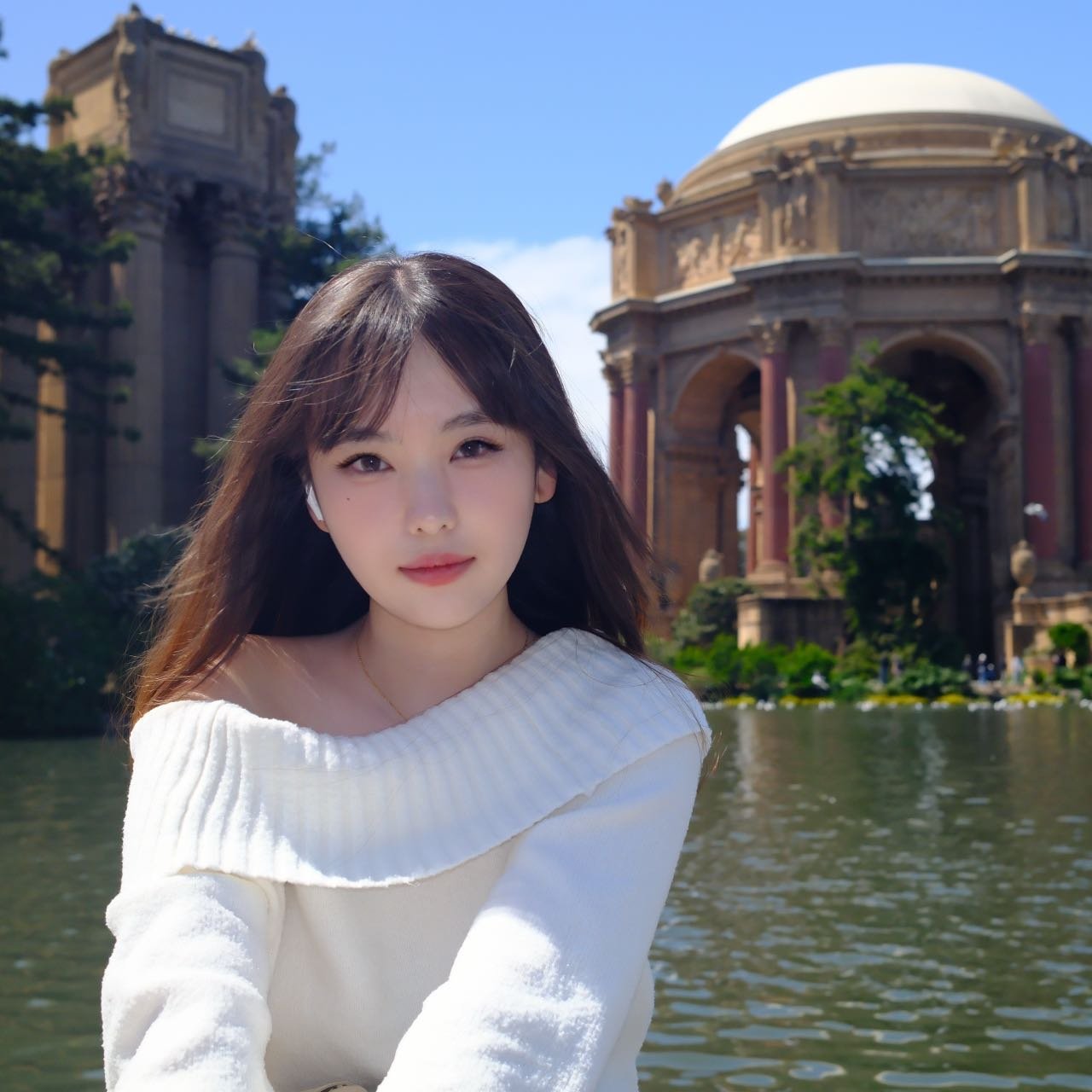
Shuhan Zhang (b. 2002, Jiangsu, China) is a curator, writer, and researcher working at the intersection of Asian diaspora studies, digital cultural platforms, and the political economy of the contemporary art market. She is currently an M.A. candidate in Visual Arts Administration at New York University and holds a B.A. from the Central Academy of Fine Arts. She is the founder of CHINCHINART, an independent curatorial platform focused on experimental exhibition formats and alternative spatial practices, and ArtEchive, a research-driven platform dedicated to contemporary art criticism, digital culture, and emerging artistic discourse.
Her research focuses on how visibility is produced, distributed, and contested within global art systems, with particular attention to Asian diasporic artists and transnational cultural flows. She examines how platform infrastructures, such as online marketplaces, social media, and algorithmic recommendation systems, reshape artistic labor, market access, and forms of cultural recognition. Her work engages with questions of who becomes visible, under what conditions, and how systems of visibility intersect with power, identity, and capital in contemporary art.
Drawing on interdisciplinary approaches including political economy, media theory, and curatorial studies, Zhang has developed the concept of “visibility curating,” a framework that understands exhibitions not only as sites of meaning-making but as structured by distribution logics and attention economies. Her recent research further investigates platformized artistic labor in digital environments, exploring how gamification mechanisms and algorithmic governance shape value production and career trajectories, particularly for emerging and diasporic artists.
In parallel with her academic work, Zhang maintains an active curatorial practice. She is the founder of CHINCHINART, through which she has organized exhibitions such as After the Face, Lithic Coordinates, Losing Ghosts, A Lure, A Lament, and Spreading Growth. Her exhibitions often translate theoretical concerns, such as perception, recognition, and instability, into spatial and experiential forms, with an emphasis on how audiences encounter and negotiate meaning.
Her writing has been published in Tussle Magazine, IMPULSE Magazine, Art Spiel, and Whitehot Magazine. Across both research and practice, Zhang is interested in how alternative curatorial and platform strategies might expand the visibility and agency of underrepresented artists within global art infrastructures.
-
2024-2026 New York University, Master of Visual Art Administration
2020-2024 Central Academy of Fine Arts, Bachelor of Art Theory
2020-2023 KEDGE Business School, Bachelor of Programme Supérieur de Gestion et Commerce
-
2025-Present Co-Founder of ArtEchive
2024-Present Co-Founder of CHINCHINART
-
2025 Gallery Internship in RAINRAIN Gallery, New York.
2025 Gallery Internship in Eli Klein Gallery, New York.
2025 Research Assistant in Asia Institute of Art & Finance, Online.
2024 Curatorial Assistant in the NYU Shanghai Institute of Contemporary Arts, Shanghai.
2023 Development Department Intern at UCCA Center for Contemporary Art, Beijing.
2023 Art Intern in Tank Shanghai, Shanghai.
-
Zhang, Shuhan. "Artistic Labor and Cultural Value under Platform Algorithm."
Zhang, Shuhan. "The Digital Shift in Contemporary Art Markets: The Impact of Technology on Valuation, Transaction, and Consumer Engagement."
Zhang, Shuhan. "The Evolution and Development of Arts Marketing in the Rising Era of Global Technology." In 2025 4th International Conference on Art Design and Digital Technology (ADDT 2025), pp. 104-113. Atlantis Press, 2025.
-
2025 Forum on Generative AI Technologies and Media Industry Applications (ICADSS_BJ 2025) Symposium of ICADSS
2025 The 10th Symposium on Architectural Anthropology & CAFA Symposium on Architectural Culture
2025 4th International Conference on Art, Design and Digital Technology (ADDT 2025)